
Quick answer: To sell medical supplies to nursing homes in Germany, (1) make sure your products meet EU Medical Device Regulation (MDR) requirements and carry a CE mark where needed, (2) understand who buys: the home’s management, the head of nursing, central purchasing for large operators, or a buying group, (3) build a targeted list of facilities by region, size and operator type, (4) reach decision-makers through compliant channels such as phone, post, trade fairs and consent-based email, and (5) offer German-language documentation, reliable delivery and local support. Germany has one of Europe’s largest care markets, but buyers expect compliance, reliability and long-term partnerships.
Key Takeaways
- Germany has around 16,000 nursing homes (Pflegeheime), according to the Federal Statistical Office’s care statistics, making it one of the largest care markets in Europe.
- Purchasing is split between independent homes, large private chains, and non-profit operators such as Caritas, Diakonie, AWO and the German Red Cross, which often buy centrally.
- Medical devices must comply with the EU MDR, and products reimbursed by health or care insurance may need to be listed in the official aids directory (Hilfsmittelverzeichnis).
- Cold email to businesses is heavily restricted in Germany under the Unfair Competition Act (UWG). Phone, post, trade fairs and opt-in email are safer routes.
- German-language materials and local service significantly improve your chances.
Why German Nursing Homes Are an Attractive Market
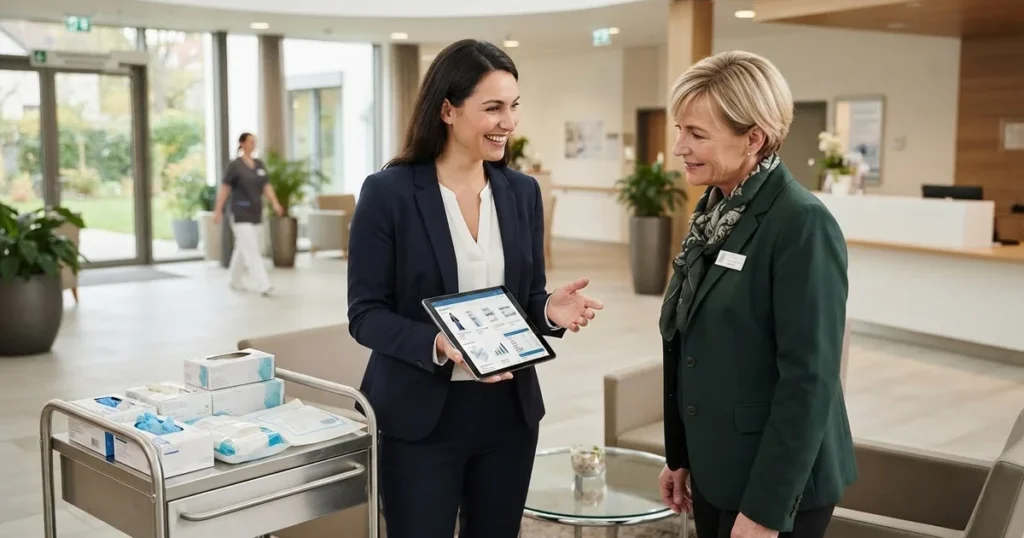
Germany’s population is among the oldest in Europe, and demand for long-term care continues to grow. Several factors make nursing homes attractive customers for medical suppliers:
- Large, stable demand: Care homes consume a steady volume of supplies such as gloves, incontinence products, wound care, hygiene and disinfection products, mobility aids and patient monitoring equipment.
- Funded system: Long-term care is financed through statutory long-term care insurance (Pflegeversicherung, under Social Code Book XI), alongside residents’ own contributions, which creates predictable budgets.
- Ongoing pressure to modernize: Staff shortages and documentation requirements are pushing homes toward digital tools, smarter equipment and products that save nursing time.
How the German Nursing Home Market Is Structured
Understanding operator types helps you target the right buyer.
| Operator type (Träger) | Examples | How they typically buy |
|---|---|---|
| Private operators | Regional and national care chains | Often central purchasing with framework contracts |
| Non-profit (freigemeinnützig) | Caritas, Diakonie, AWO, German Red Cross (DRK), Paritätischer member organizations | Mix of local purchasing and regional or national buying groups |
| Public operators | Municipal or district-run homes | May be subject to public procurement (tender) rules |
| Independent homes | Single, family-run facilities | Decisions made locally by management |
Tip: Large operators can bring volume, but sales cycles are longer. Independent homes decide faster and are a good way to build references.
Who Makes Purchasing Decisions in German Nursing Homes?
Depending on the size of the facility and the product, you’ll deal with:
- Heimleitung / Einrichtungsleitung (Facility manager): Overall responsibility, budget approval
- Pflegedienstleitung (Head of nursing): Decides on care products, workflows and clinical suitability
- Einkauf (Purchasing/procurement): Negotiates prices and framework agreements, especially in chains
- Geschäftsführung (Managing director): Final say for larger investments
- Hygienefachkraft / Qualitätsmanagement (Hygiene or quality officer): Influential for hygiene, infection control and disinfection products
For consumables, the head of nursing and purchasing are usually key. For equipment and software, expect management and the managing director to be involved.
Step-by-Step: How to Sell Medical Supplies to German Nursing Homes
Step 1: Get Your Compliance in Order
Before contacting buyers, make sure you can answer their first questions:
- EU MDR (Regulation (EU) 2017/745): Medical devices sold in the EU need conformity assessment and a CE mark. Know your device class and keep documentation ready.
- German-language labeling and instructions: Expected for products used by care staff.
- Hilfsmittelverzeichnis listing: If residents’ aids are meant to be reimbursed by statutory insurance, check whether your product needs to be listed in the official aids directory maintained by the GKV-Spitzenverband.
- Hygiene standards: Be ready to reference relevant hygiene guidelines and provide product data sheets and safety data sheets.
Step 2: Define Your Target Segment
Not every nursing home is the right fit. Segment by:
- Region (Bundesland): Start where you can deliver and support reliably.
- Facility size: Number of beds affects order volume.
- Operator type: Private chain, non-profit, public or independent.
- Care focus: Full inpatient care, short-term care, dementia care or specialized units.
Step 3: Build a Targeted Facility List
You need accurate facility data: names, addresses, operators, phone numbers, websites and general contact addresses. Options include:
- Public sources: Care insurance fund directories, regional care portals and operator websites
- Industry associations and trade fair exhibitor and visitor networks
- Ready-made datasets: A Germany nursing homes and clinics database can save weeks of manual research when you’re mapping the market by region and facility type
Whatever source you use, check how the data was collected, how often it’s updated, and whether you have a lawful basis to use it under GDPR. See our GDPR compliance page for how we handle data.
Step 4: Choose Compliant Outreach Channels
This is where many foreign suppliers make mistakes. Germany has strict rules on unsolicited marketing (see our full guide to cold email rules in Germany):
| Channel | Rules in Germany (simplified) | Best use |
|---|---|---|
| Under UWG §7, marketing emails generally require prior express consent, even to businesses | Follow-ups after consent, newsletters people signed up for | |
| Phone (B2B) | Allowed only with at least presumed consent, meaning a concrete reason to assume the business would be interested | Targeted calls with a clear, relevant offer |
| Postal mail | Generally permitted unless the recipient has opted out | Catalogs, samples, introduction letters |
| Trade fairs and events | Direct, consent-based contact | Building relationships and collecting opt-ins |
| LinkedIn / Xing | Platform rules apply; personalized, relevant messages work best | Reaching purchasing and nursing leaders |
Important: This is a simplified overview, not legal advice. Penalties and cease-and-desist letters (Abmahnungen) are common in Germany, so check your outreach plan with a German lawyer.
A practical approach: Use your facility list for postal mailings and targeted phone calls, invite contacts to request samples or a catalog, and build an opt-in email list from those who respond.
Step 5: Tailor Your Offer to Care Home Priorities

German care homes are under pressure from staff shortages and cost increases. Position your products around:
- Time savings for nursing staff
- Infection prevention and hygiene compliance
- Resident comfort and dignity
- Reliable supply and short delivery times
- Transparent pricing and framework agreements for multi-site operators
Offer free samples and trial periods. Care staff want to test products in daily use before switching.
Step 6: Show Up Where Buyers Are
- ALTENPFLEGE: Germany’s leading trade fair for the elderly care sector
- MEDICA (Düsseldorf): One of the world’s largest medical trade fairs
- Regional care congresses and association events
- Buying groups and operator supplier days
Step 7: Win Long-Term Contracts
- Start with a pilot in one or two homes, gather results, then expand across the operator’s network.
- Provide German-speaking customer service and clear delivery terms.
- Use case studies and references from other German or EU care facilities.
Common Mistakes Foreign Suppliers Make
- Sending mass cold emails, risking warnings and legal costs under UWG (what happens if you break the rules)
- English-only materials for frontline nursing staff
- Ignoring operator structures and pitching individual homes that buy centrally
- Underestimating documentation requirements under MDR and hygiene standards
- Expecting fast decisions from large chains or public operators
Frequently Asked Questions
How many nursing homes are there in Germany?
Germany has around 16,000 nursing homes, according to the Federal Statistical Office’s (Destatis) care statistics, plus a large number of outpatient care services.
Can I send cold emails to German nursing homes?
Generally no. Under Section 7 of the German Unfair Competition Act (UWG), marketing emails usually require the recipient’s prior express consent, including for businesses. Postal mail, relevant B2B phone calls and trade fairs are safer first-contact channels.
Who buys medical supplies in German nursing homes?
Typically the head of nursing (Pflegedienstleitung), facility management (Heimleitung) and, in larger operators, a central purchasing department or buying group.
Do medical supplies need a CE mark to be sold in Germany?
Medical devices must comply with the EU Medical Device Regulation (MDR) and generally carry a CE mark before being placed on the market. Requirements depend on the device class.
What products do German nursing homes buy most?
Common purchases include gloves and protective equipment, incontinence products, wound care, disinfection and hygiene products, mobility and transfer aids, beds and mattresses, and care documentation software.
What is the Hilfsmittelverzeichnis?
It’s the official directory of medical aids maintained by the GKV-Spitzenverband (National Association of Statutory Health Insurance Funds). Listing can be important if your product is meant to be reimbursed by statutory insurance.
Final Thoughts
Selling to nursing homes in Germany rewards suppliers who do their homework: compliant products, a clear target segment, lawful outreach and patient relationship-building. Start with a focused region, use accurate facility data, lead with samples and German-language support, and grow from pilot homes into long-term framework contracts.
Need help building a targeted facility list for your region? Explore our custom verified data building service or contact us.